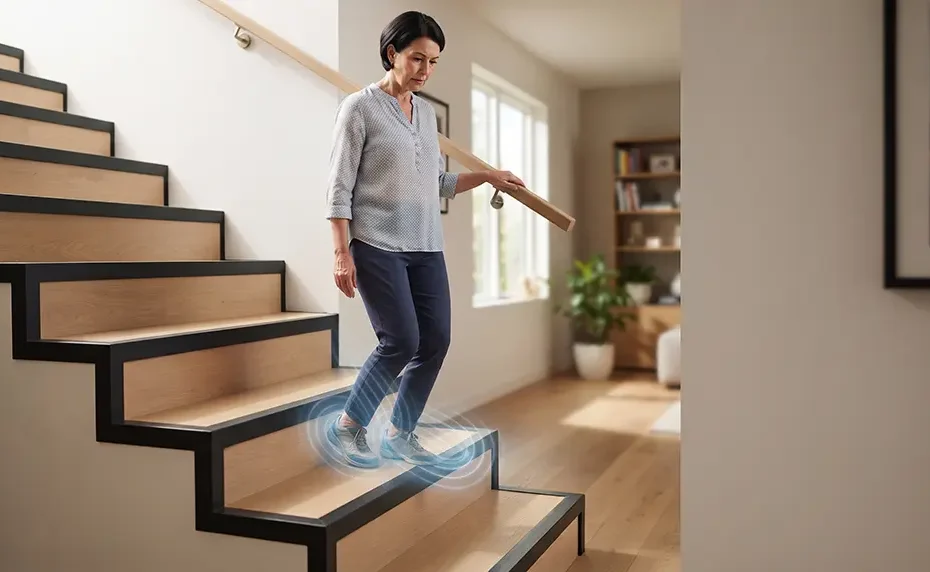
Stairs require much more sensory feedback than many people realize. The brain needs accurate information from the feet and ankles to judge where each step begins, how high or low it is, and how much weight is being transferred. Neuropathy can interfere with that feedback. Going downstairs may be especially challenging because the foot has to find a lower surface that may not be visible beneath the body while the muscles simultaneously control the descent.
- Neuropathy can reduce sensation and contribute to balance problems.
- Descending stairs requires controlled lowering and accurate foot placement.
- Darkness, carrying objects, loose footwear, or rushing can substantially increase risk.
- Using handrails and improving lighting are practical safety measures.
- The Dr. Alfonso Neuropathy Treatment Protocol is designed to support peripheral nerve function while strength and balance are addressed.
Last updated: September 22, 2026
Reviewed by: Neuropathy Relief Center of Miami clinical team
Patients frequently tell us something interesting:
“Going upstairs isn’t that bad. Going downstairs makes me nervous.”
That makes sense.
Going down stairs requires the nervous system to know precisely where the next step is before much body weight is transferred onto it.
For a person with neuropathy, reduced sensation in the feet may interfere with that information.
Patients may describe:
- “I can’t tell exactly where the step is.”
- “I watch my feet the whole way down.”
- “I need the railing.”
- “My feet feel disconnected from the stairs.”
- “I am worse in dim lighting.”
- “I almost miss the last step.”
At the Neuropathy Relief Center of Miami, this is an important functional symptom because fall prevention is one of the major concerns when sensation and balance begin to change.
Your Feet Are Sensory Organs
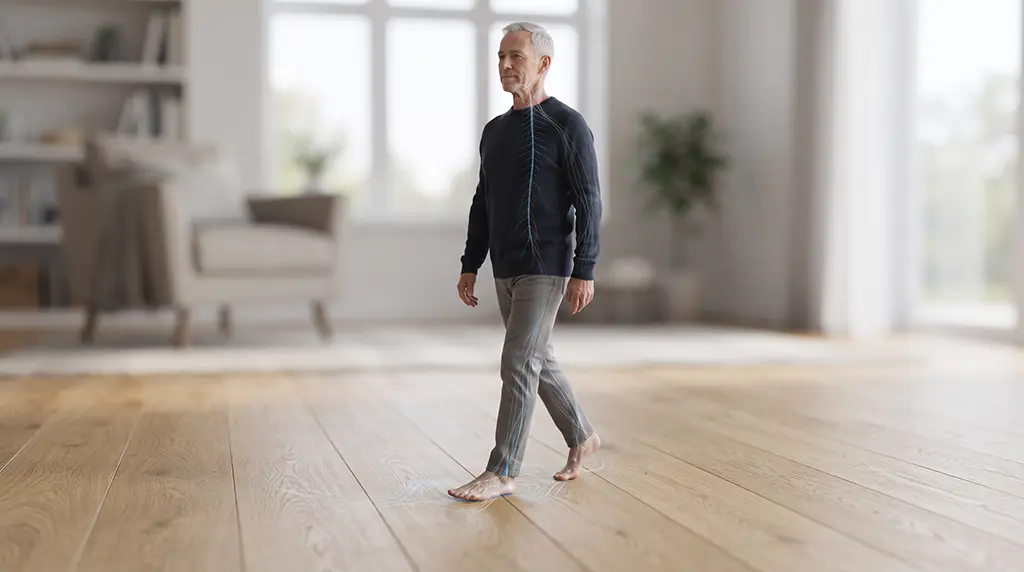
The feet do much more than support body weight.
Thousands of sensory signals help the brain understand:
- pressure
- vibration
- contact with the floor
- foot position
- weight distribution
- surface changes
Neuropathy may reduce the quality of those signals.
When that happens, the brain may rely more heavily on:
- vision
- handrails
- joint position
- muscle control
- the inner-ear balance system
This is why some neuropathy patients are much less confident when lighting is poor.
Why Going Down Is Different
Going upstairs primarily requires the body to generate enough force to lift itself.
Going downstairs requires the body to control its descent.
The foot also needs to locate a surface that is below the body.
The nervous system must estimate:
- how far down the step is
- whether the entire foot is on the step
- how much weight can be transferred
- whether the surface is slippery
- whether the ankle is stable
Reduced sensation can make this less automatic.
Why Patients Watch Their Feet
Looking down can compensate for reduced sensory feedback.
A patient may visually confirm every step because the feet are no longer providing enough information.
That strategy can work, but it has limitations.
A person carrying groceries, talking to someone, entering a dark stairwell, or navigating crowded stairs may not be able to watch every foot placement.
The Last Step Problem
Many falls happen at transitions.
The final stair can be difficult because the patient expects another step—or expects the floor before it actually arrives.
Neuropathy can make the change from stairs to flat ground harder to detect.
Pay particular attention to:
- the first step
- the last step
- unusual stair heights
- single steps at restaurant entrances
- curbs
- hotel steps
- parking garages
South Florida Stair Hazards
Local environments may include:
- wet outdoor stairs
- condominium stairwells
- parking garages
- pool decks
- cruise terminals
- boat steps
- beach access stairs
- polished tile
- rain-slick surfaces
Even patients who rarely use stairs at home may encounter them during travel and social activities.
Footwear Matters
Loose shoes make stair navigation harder.
Avoid stair climbing in footwear that:
- slips off the heel
- requires toe gripping
- has worn tread
- slides on wet surfaces
- is too large
- does not provide a stable platform
Flip-flops are particularly important to consider when stair confidence is already reduced.
Practical Stair Safety
If sensation or balance is reduced:
- use the handrail
- improve lighting
- avoid rushing
- keep stairs clear
- wear stable shoes
- avoid carrying loads that block your vision
- keep one hand available for support
- pause if the feet feel particularly numb
- consider elevators during severe flare periods
Using a handrail is not a failure.
It is intelligent risk management.
Why Closed Eyes Reveal the Importance of Sensation
Some patients notice that their balance becomes dramatically worse when they close their eyes.
This illustrates how sensory systems work together.
If the feet provide less information, vision becomes more important.
Remove visual input, and the nervous system has fewer reliable signals available to maintain balance.
This is one reason nighttime walking and dark stairwells can become difficult.
How the Dr. Alfonso Neuropathy Treatment Protocol Fits In
Fall prevention addresses the immediate safety problem.
The Dr. Alfonso Neuropathy Treatment Protocol is designed to address factors affecting peripheral nerve health through:
- 🩸 microcirculation support
- ⚡ nerve signaling and recovery support
- 🌿 inflammation and oxidative stress management
- 🧠 metabolic foundations affecting peripheral nerves
Strength and balance exercises may also be appropriate depending on the patient.
The objective is to preserve mobility not simply tell patients to stop doing things.
When to Seek Evaluation
Schedule an evaluation if:
- you consistently need to watch every step
- stairs are becoming more difficult
- one foot repeatedly catches
- you experience foot slapping
- weakness is developing
- you have near-falls
- you have already fallen
- balance is substantially worse in darkness
Safety Note
Sudden new balance loss, sudden weakness, facial changes, speech difficulty, severe dizziness, or abrupt coordination problems require urgent medical evaluation rather than assuming neuropathy is responsible.
FAQs
Why is going downstairs harder with neuropathy?
Descending requires accurate foot placement and controlled lowering while the next surface is below the body.
Why do I need to look at my feet on stairs?
Your visual system may be compensating for reduced sensory information from the feet.
Should neuropathy patients always use a handrail?
If balance or sensation is reduced, a handrail can provide an important additional point of support.
Can neuropathy treatment improve stair confidence?
Improvement depends on the cause and severity of neuropathy, but addressing nerve health, strength, balance, and environmental risk may improve function.
References
- Mayo Clinic: Peripheral Neuropathy – Symptoms and Causes
- Mayo Clinic: Balance Problems
- Mayo Clinic: Fall Prevention
- NINDS/NIH: Peripheral Neuropathy
Clinic: Neuropathy Relief Center of Miami
Address: 8585 Sunset Drive, Suite 104, Miami, FL 33143
Call: 305-274-7475
Learn more: Neuropathy Treatment Miami
Book your consultation today: Appointments

Sincerely Yours for Health,
Dr. Rodolfo Alfonso, D.C.
8585 Sunset Drive,
STE 104
Miami, FL 33143
Ph: 305-275.7475
www.neuropathyreliefmia