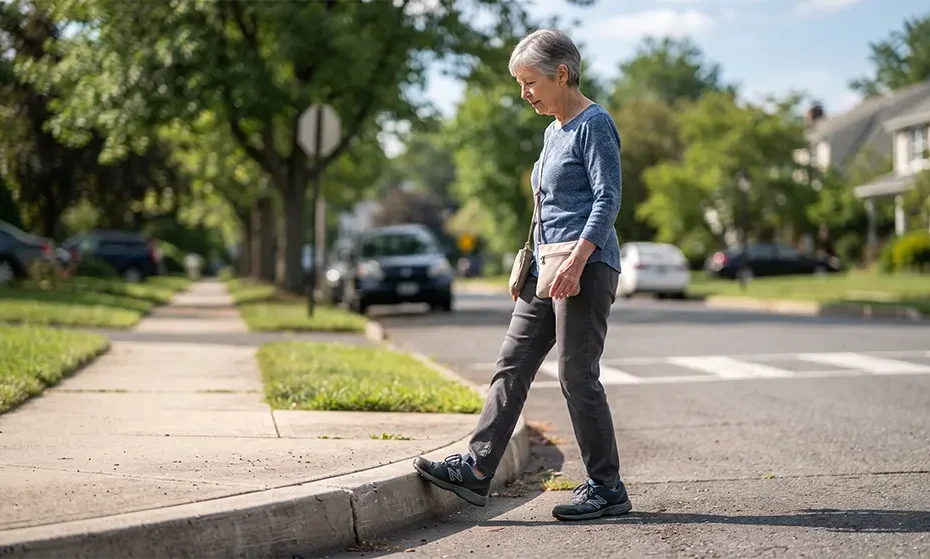
Curbs, uneven sidewalks, parking lots, and small step-downs can become risky for neuropathy patients because reduced foot sensation affects balance, depth awareness, and reaction time. What looks like a small step can become a fall hazard when the feet do not clearly communicate pressure, position, or surface changes. Better footwear, slower transitions, daily balance awareness, and nerve-focused care can reduce fall risk.
- Neuropathy reduces protective sensation and ground feedback from the feet.
- Curbs and uneven sidewalks are dangerous because they require quick balance adjustments.
- Footwear, lighting, pacing, and the Dr. Alfonso Neuropathy Treatment Protocol can help protect mobility and confidence.
Last updated: April 14, 2026
Reviewed by: Neuropathy Relief Center of Miami team
Many neuropathy patients are careful on stairs but forget about curbs. Yet curbs are one of the most common places where people trip, stumble, or lose confidence.
Patients often tell us:
- “I didn’t see the curb clearly.”
- “My foot caught the edge.”
- “I felt like my foot didn’t know where the ground was.”
- “I almost fell stepping down from the sidewalk.”
- “Parking lots make me nervous now.”
At the Neuropathy Relief Center of Miami, we see this in patients throughout Miami, Fort Lauderdale, Miami-Dade County, Broward County, and the Florida Keys. We also see visitors from the USA, Colombia, Chile, Argentina, Mexico, and the Caribbean who flare or stumble more during travel because they are walking unfamiliar sidewalks, hotel entrances, parking lots, and beach-access paths.
This blog is educational. If you have frequent falls, new weakness, sudden numbness, or one-sided symptoms, seek medical evaluation promptly.
Why curbs are difficult with neuropathy
Curbs seem simple, but they require several systems to work together:
- Vision
- Foot sensation
- Ankle control
- Hip stability
- Balance reactions
- Depth perception
- Confidence
Neuropathy affects the sensory part of this system. When your feet do not clearly report where the ground is, your brain must rely more heavily on vision and muscle bracing.
The problem with reduced ground feedback
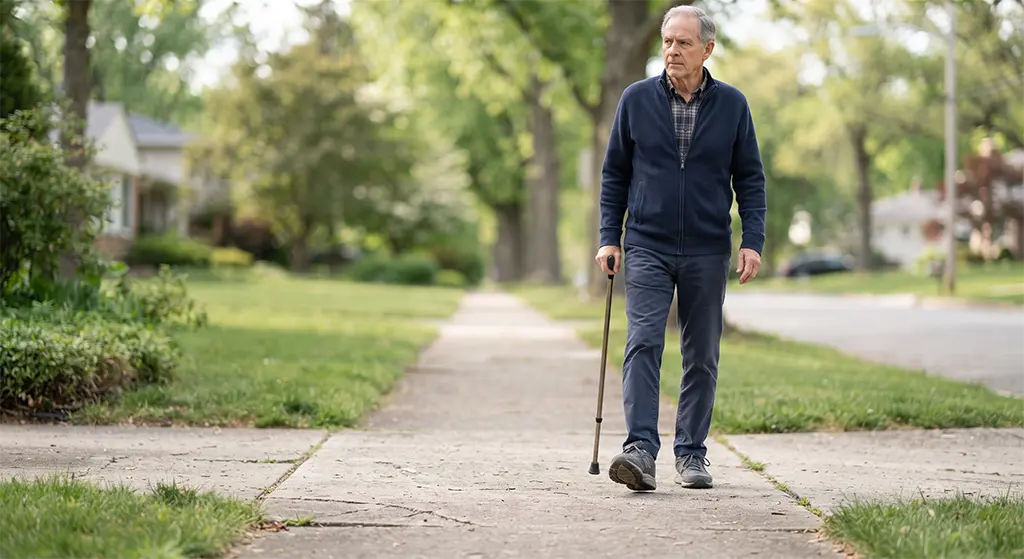
Your feet constantly tell the brain:
- how much pressure is under the heel
- where the toes are
- whether the surface is flat or sloped
- whether the foot is sliding
- whether the step is higher or lower than expected
When neuropathy reduces that feedback, curbs become less predictable. The curb may be only a few inches tall, but if your foot does not sense the landing clearly, your balance has to work harder.
Why step-downs are harder than step-ups
Stepping up requires strength. Stepping down requires control. When you step down from a curb, your body has to lower weight, absorb impact, and adjust instantly to the new surface.
That is why many patients say going down curbs or steps feels worse than going up.
If your feet are numb, “cottony,” or buzzing, your landing foot may not give enough feedback. That can create a hard landing, ankle wobble, or protective bracing.
Why Miami and South Florida increase curb risk
In Miami, Fort Lauderdale, Miami-Dade, Broward, and the Florida Keys, daily walking often includes:
- uneven sidewalks
- beach walkways
- parking stops
- wet pavement
- tile entrances
- curb cuts
- construction areas
- sand near sidewalks
- bright sun and glare
Glare is a major issue. Bright sunlight can make curb edges harder to judge, especially when stepping from a shaded area into sun or from sun into shade.
Visitors from Colombia, Chile, Argentina, Mexico, and the Caribbean may also be walking more than usual while visiting South Florida, which increases fatigue and fall risk.
The “near-fall” warning sign
A near-fall is not nothing. It is information.
If you stumble but catch yourself, your nervous system just showed you that one part of the balance system is struggling. Do not wait until a real fall happens to make changes.
Common near-fall signs include:
- catching the toe on curb edges
- feeling unstable stepping down
- needing to grab someone’s arm
- avoiding curbs altogether
- feeling worse in low light
- looking down constantly while walking
Footwear matters more than most people think
With neuropathy, shoes are part of your safety system.
For curbs and sidewalks, avoid unstable footwear like thin flip-flops, loose sandals, or shoes that slide. Look for:
- secure heel
- stable sole
- roomy toe box
- good traction
- enough structure to reduce wobble
This does not mean shoes have to be heavy or uncomfortable. It means the shoe should give the foot a stable platform.
Practical curb strategies
Slow down before the curb
Do not step down at full walking speed. Slow down, position both feet, then step.
Look before stepping
Use your eyes to replace some of the missing foot feedback. Scan the curb edge, surface color, wet areas, and slope.
Step down with control
Avoid dropping off the curb quickly. Think “controlled landing.”
Use hand support when available
Railings, walls, or a stable companion can help when fatigue is high.
Avoid distractions
Do not text while crossing curbs or parking lots. Neuropathy requires more attention to the ground.
Be extra cautious at night
Low light removes visual backup. Use well-lit paths whenever possible.
How the Dr. Alfonso Neuropathy Treatment Protocol helps
The Dr. Alfonso Neuropathy Treatment Protocol is designed to support:
- 🩸 Microcirculation to the feet and legs
- ⚡ Nerve signaling stability and repair support
- 🌿 Inflammation and oxidative stress reduction
- 🧠 Metabolic foundations that influence nerve function
As nerve signaling improves, many patients report better ground awareness, more confidence walking, and fewer moments where the feet feel disconnected from the surface.
When to seek evaluation
Get evaluated if:
- you have had a fall or repeated near-falls
- you catch your toes more often
- balance is worse in low light
- numbness is spreading upward
- you feel foot slapping when walking
- you develop wounds or skin injuries you did not feel
FAQs
Why are curbs hard with neuropathy?
Curbs require accurate foot sensation, depth awareness, and balance control. Neuropathy reduces ground feedback, making step-downs less predictable.
Is stepping down harder than stepping up?
Often yes. Stepping down requires braking and controlled landing, which is harder when sensation is reduced.
What shoes help with curb safety?
Stable shoes with traction, secure heel support, and a roomy toe box are usually safer than loose sandals or thin flip-flops.
Can neuropathy treatment improve walking confidence?
Many patients report better confidence as nerve signaling, circulation, and balance awareness improve.
References
- NINDS: Peripheral Neuropathy overview
- CDC: Foot care and fall-prevention principles for reduced sensation
Clinic: Neuropathy Relief Center of Miami
Address: 8585 Sunset Drive, Suite 104, Miami, FL 33143
Call: 305-274-7475
Learn more: Neuropathy Treatment Miami
Book your consultation today: Appointments

Sincerely Yours for Health,
Dr. Rodolfo Alfonso, D.C.
8585 Sunset Drive,
STE 104
Miami, FL 33143
Ph: 305-275.7475
www.neuropathyreliefmia