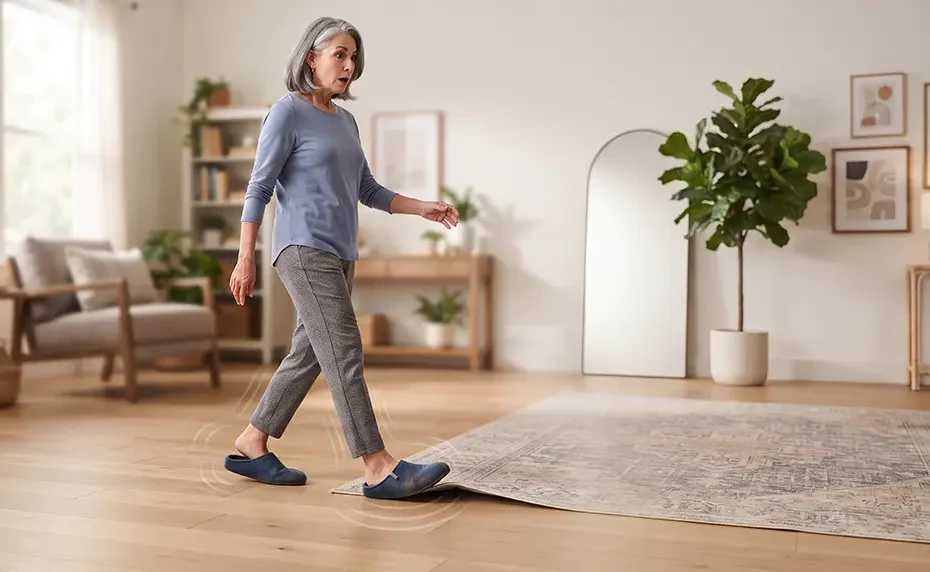
House slippers may feel comfortable, but loose backs, worn soles, oversized sizing, and soft unstable material can become a problem for neuropathy patients. Reduced foot sensation makes it harder to know exactly where the slipper is underneath the foot. If slippers slide, fold, catch on rugs, or require the toes to grip to keep them on, they may increase fall risk.
- Loose slippers may move independently from the foot and interfere with ground awareness.
- Neuropathy can make it harder to feel when a slipper is twisted or partially off.
- Secure indoor footwear is often safer than barefoot walking or loose slip-ons.
- The Dr. Alfonso Neuropathy Treatment Protocol supports peripheral nerve function while patients reduce environmental fall risks.
Last updated: September 15, 2026
Reviewed by: Neuropathy Relief Center of Miami team
Many neuropathy patients are careful about outdoor footwear and then walk around the house in loose slippers.
That can be a mistake.
Patients often say:
- “My slipper catches the floor.”
- “Sometimes it slides halfway off and I don’t notice.”
- “I shuffle around the house.”
- “My toes grip to hold the slipper on.”
- “I nearly tripped over the front of my slipper.”
- “Bare feet hurt on my tile, so I wear soft slippers.”
This is especially relevant in Miami, Miami Beach, Fort Lauderdale, Miami-Dade, Broward, and the Florida Keys, where tile floors are extremely common.
At the Neuropathy Relief Center of Miami, we want patients to remain active and independent. Indoor footwear is a small detail that can have a major effect on fall prevention.
Why slippers can become unstable
Many traditional slippers have:
- open heels
- soft soles
- oversized openings
- little structure
- worn tread
- flexible fronts
- minimal support
They may be comfortable while sitting but unstable while walking.
If a slipper moves under the foot, a patient with neuropathy may not immediately sense the change.
The toe-gripping problem
Loose footwear often requires the toes to grip downward to keep the shoe attached.
That may contribute to:
- forefoot fatigue
- toe cramping
- altered walking
- shorter steps
- shuffling
- increased instability
If the foot is already numb, the patient may not realize how much they are compensating.
Why tile floors make the problem worse

South Florida homes frequently have hard tile.
Tile can be:
- slippery
- unforgiving
- cold
- wet near kitchens and bathrooms
- difficult for a loose slipper to grip
A patient may choose slippers because barefoot tile is uncomfortable, but the slipper itself needs to be safe.
What makes a better house shoe?
Look for:
- secure heel support
- non-slip tread
- correct sizing
- wide stable base
- cushioning
- enough toe room
- easy fastening
- no internal seams or pressure spots
The footwear should move with your foot, not independently from it.
Check old slippers
Footwear does not need to look damaged to become unsafe.
Look at the bottom.
Replace or stop using slippers if:
- tread is worn smooth
- heel collapses sideways
- sole separates
- interior bunches up
- slipper stretches too large
- toes hang over the front
- you repeatedly catch the floor
Barefoot is not necessarily better
Some neuropathy patients decide to eliminate the slipper and walk barefoot.
That can create a different set of risks:
- cuts
- splinters
- small objects
- hot surfaces
- hard-floor pressure
- dropped objects
- unnoticed wounds
If protective sensation is reduced, stable indoor footwear usually provides an additional layer of protection.
Nighttime matters
Loose slippers can be particularly dangerous during nighttime bathroom trips.
At night:
- lighting is lower
- the patient may be sleepy
- feet may feel numb after lying down
- balance reactions are slower
- rugs and thresholds are harder to see
A secure house shoe combined with good lighting may significantly reduce risk.
How the Dr. Alfonso Neuropathy Treatment Protocol helps
Footwear changes reduce immediate environmental risk.
The Dr. Alfonso Neuropathy Treatment Protocol focuses on the nerve environment itself through:
- 🩸 Microcirculation
- ⚡ Nerve signaling stability and repair support
- 🌿 Inflammation and oxidative stress reduction
- 🧠 Metabolic foundations affecting peripheral nerve health
As nerve signaling improves, patients may experience better awareness of the feet and greater confidence during walking.
When to seek evaluation
Seek evaluation if:
- you shuffle while walking
- toes repeatedly catch
- balance is declining
- one foot drags
- slippers frequently come off without you noticing
- you have near-falls
- you rely on furniture for support
- numbness is worsening
FAQs
Are slippers safe for neuropathy?
Some are. Secure, properly fitted slippers with traction are generally preferable to loose, unstable slip-ons.
Why do my toes grip inside slippers?
Your toes may be attempting to keep loose footwear attached to your feet.
Is barefoot walking safer?
Not necessarily. Reduced sensation can make unnoticed cuts, heat exposure, and objects on the floor more dangerous.
What is the best type of indoor footwear for neuropathy?
A stable house shoe with heel security, traction, cushioning, adequate toe room, and proper fit is generally safer.
References
- CDC: Foot care and footwear guidance
- NINDS/NIH: Peripheral Neuropathy
- CDC: Fall prevention principles
Clinic: Neuropathy Relief Center of Miami
Address: 8585 Sunset Drive, Suite 104, Miami, FL 33143
Call: 305-274-7475
Learn more: Neuropathy Treatment Miami
Book your consultation today: Appointments

Sincerely Yours for Health,
Dr. Rodolfo Alfonso, D.C.
8585 Sunset Drive,
STE 104
Miami, FL 33143
Ph: 305-275.7475
www.neuropathyreliefmia