
Some people improve their blood sugar and lose weight but still feel neuropathy symptoms. Nerves heal slowly, and symptoms can persist due to prior damage, ongoing inflammation, circulation factors, nutrient issues, or mechanical compression. The next step is a nerve-focused plan and consistent progress tracking.
- Better A1C is great, but nerve recovery often lags behind metabolic improvement.
- Neuropathy can persist if circulation, inflammation, or compression drivers remain.
- A targeted treatment protocol plus trigger control can improve outcomes over time.
Last updated: April 14, 2026
Reviewed by: Neuropathy Relief Center of Miami team
A common story:
- “I lost weight.”
- “My A1C improved.”
- “My doctor says I’m doing better.”
…yet feet still burn, tingle, or feel numb.
We see this across Miami, Fort Lauderdale, Miami-Dade, Broward, the Florida Keys, and in visitors from the USA, Colombia, Chile, Argentina, Mexico, and the Caribbean.
The truth is: nerve recovery can be slower than metabolic improvement.
Why symptoms can persist even after improvement
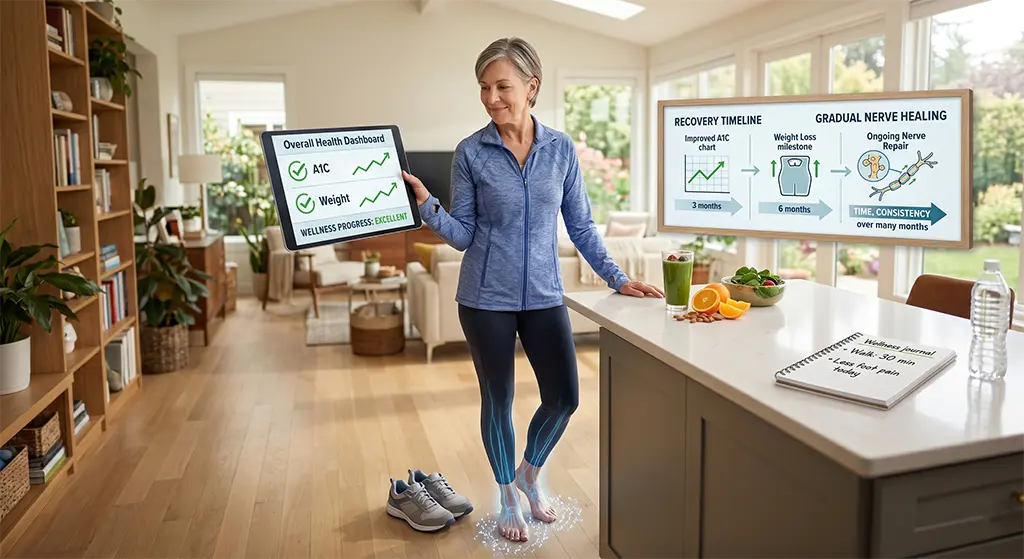
Nerves heal slowly
Nerve tissue often recovers more slowly than blood sugar numbers change.
Prior damage may still be present
If nerve fibers were already irritated or damaged, improved numbers don’t instantly reverse the structural and signaling changes.
Inflammation and oxidative stress can remain
Even with improved weight and A1C, lifestyle stressors, sleep, and inflammation can keep symptoms active.
Circulation and microvascular factors
Improving glucose is important, but microcirculation and tissue resilience can still need support.
Overlap with compression or mechanical drivers
Some patients have both metabolic neuropathy and mechanical compression neuropathy. Improving blood sugar doesn’t fix nerve compression from structural load.
What to do next (general guidance)
- Track symptom patterns (night vs day, heat vs cold, after meals vs after standing).
- Address footwear and friction triggers.
- Improve sleep consistency.
- Evaluate whether symptoms are spreading or affecting balance.
- Build a nerve-focused plan rather than waiting passively.
How the Dr. Alfonso Neuropathy Treatment Protocol helps
The protocol targets the nerve environment by supporting:
- 🩸 microcirculation.
- ⚡ nerve signaling stability and repair support.
- 🌿 inflammation and oxidative stress reduction.
- 🧠 metabolic foundations.
Many patients see improvement when they combine metabolic improvements with targeted nerve support.
FAQs
Can neuropathy persist after A1C improves?
Yes. Nerves often recover slowly, and symptoms may lag behind metabolic changes.
Does that mean I’m not improving?
Not necessarily recovery can take time, and other drivers may need addressing.
What should I track?
Symptom severity, triggers (meals, heat, standing), sleep quality, balance changes.
Can treatment still help?
Many patients improve with targeted care and trigger reduction.
References
- ADA: Neuropathy education and metabolic control
- NINDS: Peripheral neuropathy overview
Clinic: Neuropathy Relief Center of Miami
Address: 8585 Sunset Drive, Suite 104, Miami, FL 33143
Call: 305-274-7475
Learn more: Neuropathy Treatment Miami
Book your consultation today: Appointments

Sincerely Yours for Health,
Dr. Rodolfo Alfonso, D.C.
8585 Sunset Drive,
STE 104
Miami, FL 33143
Ph: 305-275.7475
www.neuropathyreliefmia