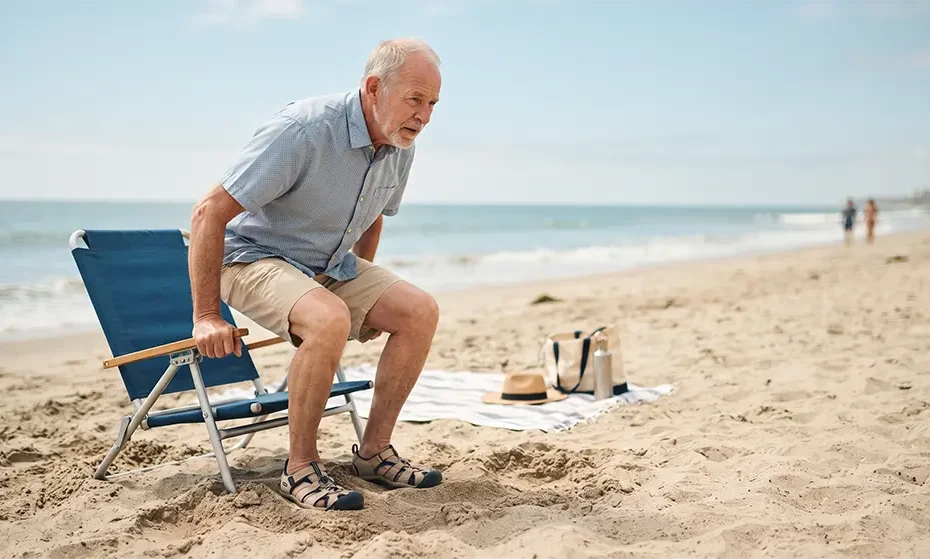
Low beach chairs can be difficult for neuropathy patients because standing up from sand requires leg strength, balance, foot feedback, hip control, and quick stabilization. If your feet are numb, burning, or unstable, getting up from a low chair can increase fall risk. A safer beach setup can protect independence while you continue enjoying South Florida outdoor life.
- Low chairs make the body work harder to stand, especially on soft sand.
- Neuropathy reduces foot feedback, making beach transitions more unstable.
- Better chair height, footwear, pacing, and nerve-focused care can improve safety and confidence.
Last updated: April 14, 2026
Reviewed by: Neuropathy Relief Center of Miami team
Beach days are part of life in Miami, Fort Lauderdale, Miami-Dade County, Broward County, and the Florida Keys. But for neuropathy patients, one of the biggest risks is not the ocean or the walk. It is getting up from a low beach chair.
Patients often say:
- “I struggle getting up from low chairs.”
- “My feet feel numb in the sand.”
- “I feel unstable standing up at the beach.”
- “My legs feel weak after sitting.”
- “The chair is low, the sand shifts, and I feel like I might fall.”
At the Neuropathy Relief Center of Miami, we see this in local patients and visitors from the USA, Colombia, Chile, Argentina, Mexico, and the Caribbean who want to stay active, social, and independent without unnecessary fall risk.
This blog is educational. If you have repeated falls, severe weakness, foot drop, dizziness, or rapidly worsening balance, seek evaluation.
Why low beach chairs are difficult
A low chair requires more strength and control than a normal chair. The knees and hips bend more deeply, and the body must generate enough force to stand from a low position.
On sand, the challenge increases because the surface shifts under the feet.
This requires:
- leg strength
- ankle stability
- foot sensation
- balance confidence
- hip control
- trunk control
- timing
Neuropathy can interfere with several of these systems.
Why sand makes it harder
Sand is unstable. The feet may sink, slide, or shift while standing. Neuropathy reduces the ability to feel those changes quickly.
That means the patient may stand up and realize too late that the feet are not secure.
Common problems include:
- foot slipping
- ankle wobbling
- delayed balance correction
- toe gripping
- calf cramping
- fear of falling backward
- needing help to stand
The numb-feet transition problem
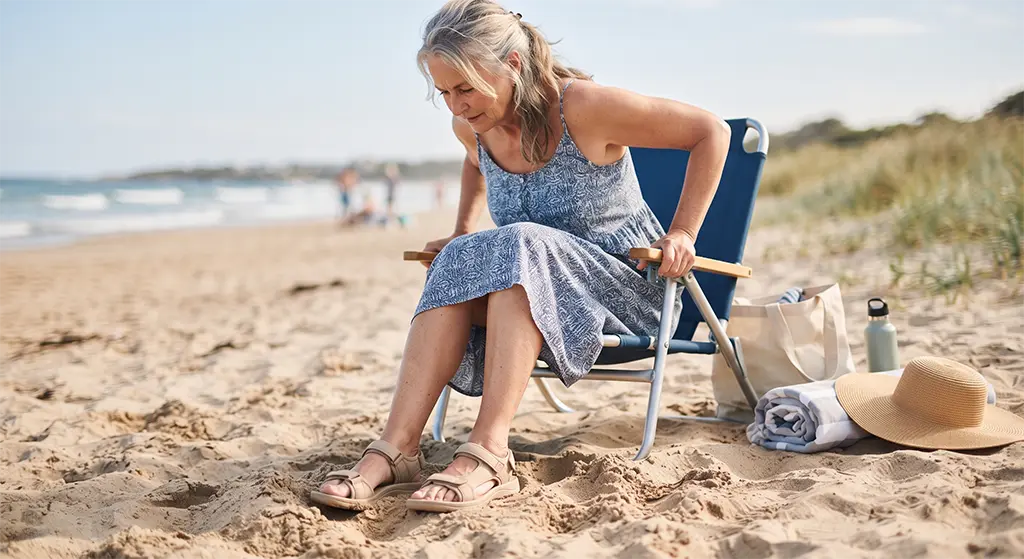
When patients sit for a while, the feet may feel more numb or disconnected. Then they stand up on sand, which already provides poor feedback.
A risky sequence looks like this:
- Patient sits in low chair
- Feet become numb or stiff
- Sand shifts under the feet
- Patient pushes up quickly
- Balance correction is delayed
- Patient stumbles or grabs for support
This is preventable with better setup and slower transitions.
Better beach chair choices
For neuropathy patients, chair height matters.
Look for:
- higher seat height
- sturdy armrests
- stable frame
- easy entry and exit
- lightweight but secure design
- minimal sinking into sand
- enough support to push up safely
A very low beach chair may look convenient, but it can create unnecessary risk.
Footwear on sand
Some patients prefer barefoot sand walking. Others feel safer with supportive sandals or beach shoes. The best choice depends on sensation, balance, skin condition, and heat exposure.
If sensation is reduced, inspect feet carefully after beach time. Sand, shells, hot surfaces, and straps can cause injury without strong pain signals.
Safer standing strategy
Before standing:
- place both feet firmly
- clear sand under the feet if needed
- lean forward with control
- use chair arms
- avoid twisting while standing
- pause once upright
- take the first steps slowly
- ask for help if the sand is unstable
There is no shame in using support. Preventing a fall is the priority.
How the Dr. Alfonso Neuropathy Treatment Protocol helps
The Dr. Alfonso Neuropathy Treatment Protocol supports:
- 🩸 Microcirculation to the feet and legs
- ⚡ Nerve signaling stability and repair support
- 🌿 Inflammation and oxidative stress reduction
- 🧠 Metabolic foundations that influence balance, strength, and recovery
As nerve signaling improves, many patients report better ground awareness, more confidence standing, and fewer beach-related flares.
When to seek evaluation
Seek evaluation if:
- you struggle getting up from chairs
- sand makes you feel unsafe
- feet feel numb after sitting
- you have near-falls
- balance is worse outdoors
- foot slapping or toe catching appears
- numbness is spreading
FAQs
Why are low beach chairs hard with neuropathy?
They require more leg strength, balance, and foot feedback, especially on shifting sand.
Is sand risky for neuropathy patients?
It can be. Sand is uneven, hot, and may hide sharp objects or shells.
What kind of chair is safer?
A higher chair with sturdy armrests and stable support is usually safer than a very low beach chair.
Can treatment improve beach confidence?
Many patients improve as nerve signaling, microcirculation, and balance feedback improve.
References
- CDC: Fall prevention and foot safety guidance
- NINDS: Peripheral Neuropathy overview
Clinic: Neuropathy Relief Center of Miami
Address: 8585 Sunset Drive, Suite 104, Miami, FL 33143
Call: 305-274-7475
Learn more: Neuropathy Treatment Miami
Book your consultation today: Appointments

Sincerely Yours for Health,
Dr. Rodolfo Alfonso, D.C.
8585 Sunset Drive,
STE 104
Miami, FL 33143
Ph: 305-275.7475
www.neuropathyreliefmia